
Menopause can make familiar skin feel unexpectedly different. A moisturizer that worked for years may suddenly seem too light, fine lines may become more noticeable, and the cheeks or jawline can start losing some of their previous firmness. These changes aren’t happening because you’ve suddenly started caring for your skin incorrectly. Shifting hormone levels affect the way skin holds moisture, produces collagen, and maintains its structure.
The good news is that menopause skin changes can be approached from several angles. At The Sandbar Beauty Company, treatments such as lasers, microneedling, PRP, injectables, facial fillers, biostimulators, PDO threads, and wellness services can be considered according to what your skin is actually doing.
Continue reading to understand why menopause changes the complexion and which treatment categories may help address the concerns that come with it.
Treat the Change, Not Just the Wrinkle
Good menopause skin care starts by recognizing that several things are changing at once. Dryness, laxity, uneven texture, volume loss, and fine lines can have different causes, so a thoughtful treatment plan usually works better than trying to solve everything with one procedure.
1. Start With the Role of Estrogen
One of the biggest hormonal shifts during menopause involves estrogen. This hormone influences several functions within the skin, including collagen production, hydration, thickness, elasticity, and oil production. As estrogen levels decline, those changes can become increasingly visible.
For some women, the first thing they notice is dryness. Others see thinner-looking skin, softer facial contours, or wrinkles that suddenly seem more established. These changes may develop gradually, but menopause can make them feel as though they’ve accelerated.
This is why treatment should begin with a proper assessment. A dry complexion may need a different approach from pronounced laxity, even when both concerns developed during the same hormonal transition.
Understanding the role of estrogen also helps set realistic expectations. Cosmetic treatments can improve visible concerns, but they don’t recreate the hormonal environment of younger skin. The goal is to support the skin you have now rather than chase a version of it from decades ago.
2. Collagen Loss Becomes More Noticeable
Collagen gives skin much of its firmness and structural support. Production naturally decreases with age, but menopause can make collagen loss more apparent as hormonal changes affect how the skin maintains this supportive protein.
The result can show up as thinner skin, fine lines, creasing, and reduced firmness. Areas that once looked smooth may begin appearing more textured, while the lower face may lose some definition. This is where collagen-stimulating treatments can become especially relevant.
Microneedling is one option offered by The Sandbar Beauty Company. The treatment creates controlled micro-injuries in the skin, which stimulates a natural repair response and supports new collagen production over time.
Unlike filler, microneedling doesn’t work by adding volume beneath the skin. Its role is more about improving the quality and resilience of the skin itself. That can make it particularly appealing for patients whose main concern is texture, fine lines, or early thinning rather than significant volume loss.

3. Laser Treatments Can Address Texture and Sun Damage
Menopause doesn’t erase the years of sun exposure your skin accumulated beforehand. In fact, as skin becomes thinner or less even, older signs of photodamage may become more noticeable.
Laser treatments can be considered for concerns such as uneven tone, rough texture, sun damage, and selected signs of aging. Depending on the technology used, laser energy may support skin renewal or target specific pigment and textural concerns.
For menopausal patients, this can be useful when aging appears as more than just wrinkles. Brown spots, dullness, uneven color, and roughness may all contribute to the feeling that the complexion looks older or more tired.
However, laser treatment should be tailored carefully. Skin can become drier or more reactive during menopause, so the strongest possible setting isn’t automatically the smartest choice.
A consultation helps determine which laser approach makes sense for your skin type, pigmentation tendencies, treatment goals, and recovery preferences. The goal is improvement without unnecessarily stressing a skin barrier that may already be more vulnerable.
4. Microneedling Can Support Collagen Decline
The phrase collagen decline sounds abstract until you start noticing what it looks like in the mirror. Skin may feel less firm, fine lines may linger, and texture can become less smooth. Microneedling works by creating a controlled repair response. As the skin heals, it produces new collagen and other supportive components involved in skin remodeling.
That gradual process makes microneedling a useful option for patients who prefer results that develop naturally over time. You won’t leave the appointment with an entirely different face. Instead, improvements can emerge progressively as the skin goes through its remodeling cycle. This approach may be especially helpful when concerns include fine lines, enlarged-looking pores, mild acne scarring, or general texture changes.
Several sessions may be recommended depending on the concern and treatment plan. Skin response, medical history, and tolerance for downtime should guide frequency rather than automatically repeating treatment on a fixed schedule.
5. PRP Can Add a Regenerative Element
PRP treatments use platelet-rich plasma derived from the patient’s own blood. The plasma contains platelets and growth factors that are involved in normal tissue repair processes. Within aesthetic care, PRP may be used alone or alongside procedures such as microneedling. The goal is to support rejuvenation rather than add synthetic volume.
This can be attractive to menopausal patients who are interested in regenerative approaches. PRP does not replace lost estrogen or reverse menopause, but it can be part of a strategy focused on supporting skin quality.
Its role is also different from laser treatment or filler. Laser addresses selected skin concerns through energy, filler restores volume, and PRP works through biologically active components from the patient’s own blood.
A good treatment plan gives each procedure a clear job. Combining treatments just because they’re available doesn’t automatically create better results.
6. Biostimulators Can Help When Structure Is Fading
Some women notice that their skin isn’t simply wrinkled. The face appears less supported overall. This is where facial biostimulators may become relevant. Biostimulatory injectables are designed to encourage collagen production over time, supporting gradual improvements in facial structure and volume.
That makes them different from traditional fillers, which can create more immediate volume restoration. For menopause-related changes, the slow-building nature of biostimulators can be appealing. The result develops as collagen production increases, allowing facial rejuvenation to evolve gradually rather than appearing suddenly after one appointment.
They can be useful when the goal is not to create prominent cheekbones or dramatically change facial proportions, but to support areas affected by age-related structural changes. As always, candidacy matters. Skin quality, facial anatomy, existing volume loss, and treatment history should all be considered before choosing between filler, a biostimulator, or another approach.
7. Filler Can Restore Lost Facial Volume
Menopause-related aging isn’t only about what happens at the surface. Facial fat compartments and deeper structures also change with age, which can make the cheeks look flatter or cause certain folds and hollows to become more obvious. Facial filler can help restore selected areas of lost volume.
The important word is “selected.” A more youthful-looking face isn’t created by filling every line. Strategic treatment focuses on restoring support where it has been lost while maintaining natural proportions.
For some patients, a small amount of filler may be enough to improve balance. Others may be better suited to a biostimulator or skin-focused treatment first. This is why looking at the whole face matters. A line beside the mouth may appear deeper because cheek support has diminished, not because the line itself needs direct filling.
Thoughtful filler treatment addresses the structure creating the concern rather than chasing individual wrinkles one at a time.
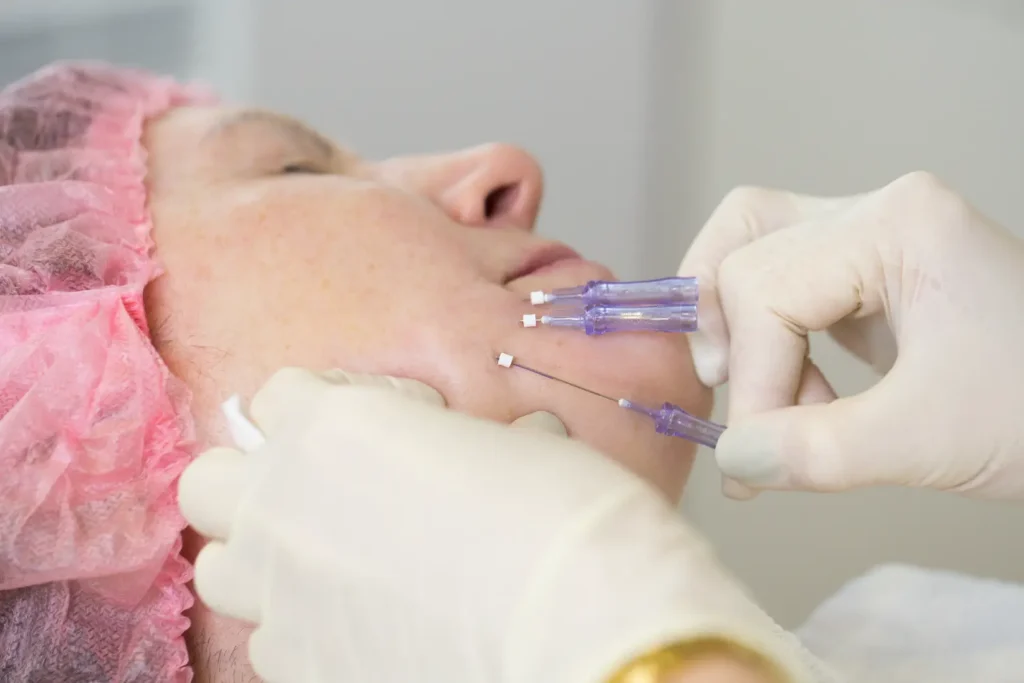
8. PDO Threads May Help Selected Laxity
As estrogen decreases and collagen support weakens, laxity can become more noticeable along the cheeks, jawline, and lower face. PDO thread lift treatments offer a non-surgical option for selected patients who want some lifting support without surgery.
Threads are placed beneath the skin to provide mechanical support while also creating a local healing response. They may be useful for mild to moderate laxity, depending on facial anatomy and expectations.
However, they can’t reproduce the results of a surgical facelift when loose skin is significant. That distinction matters because patients sometimes search for a crepey skin treatment and assume any “lifting” procedure will solve both skin texture and deeper laxity.
Crepey skin may require a combination approach involving collagen-focused treatments, resurfacing, skincare, or another modality. PDO threads address a specific problem. They shouldn’t be expected to do every job.
Let Your Skin Evolve With You
Menopause changes the skin, but those changes don’t mean your complexion has stopped responding to good care. Reduced estrogen, collagen decline, dryness, and structural changes simply mean your treatment plan may need to evolve along with you.
At The Sandbar Beauty Company in Pompano Beach, FL, patients can explore a laser med spa approach that includes laser treatments, microneedling, PRP, injectables, facial fillers, biostimulators, PDO threads, ultrasound dissolving, and wellness services. The right plan doesn’t try to make you look like someone else. It supports healthier-looking skin and a refreshed version of the face that’s already yours.
Contact us today to book your consultation!